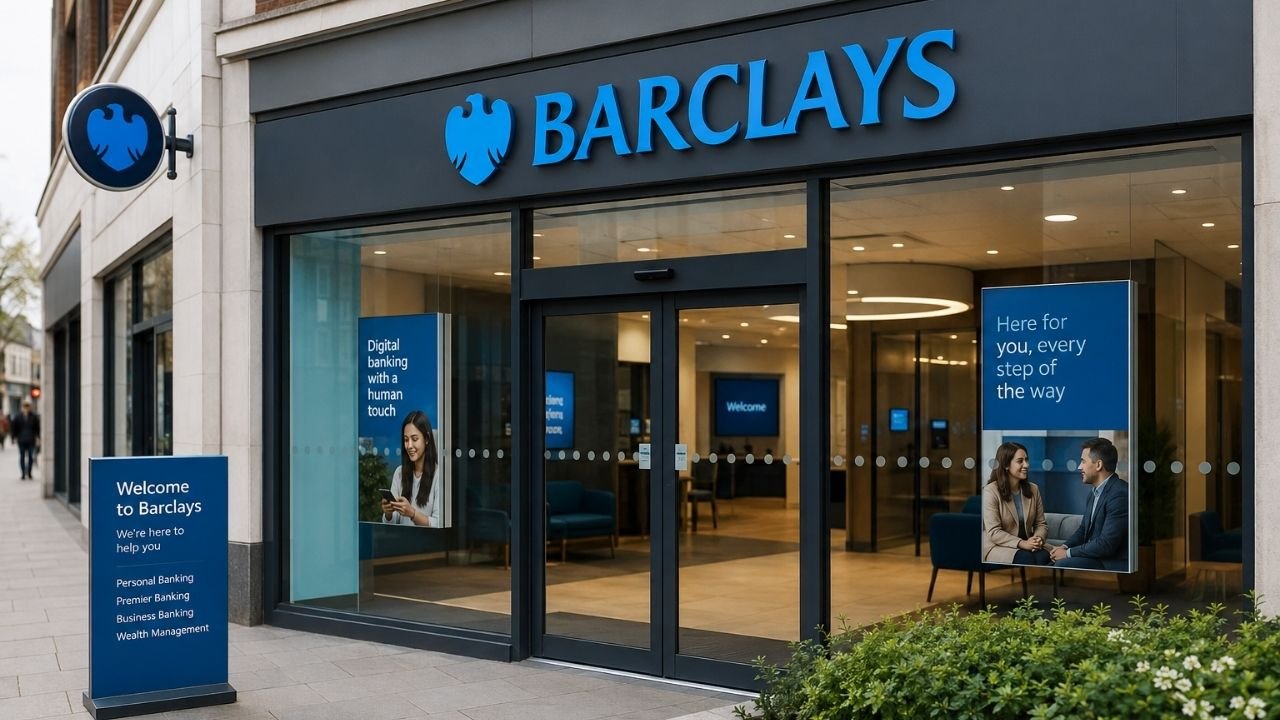
Barclays is making an important change to its approach to physical banking in the UK. After years of reducing its high-street network, the bank is now looking at expanding its physical presence again, opening or relocating selected branches and placing greater emphasis on face-to-face customer support.
The development is particularly notable because Barclays has closed more than 800 branches since 2018, leaving around 206 branches in the UK according to reporting based on the bank’s latest annual report. In 2026, however, Barclays UK chief executive Vim Maru said the bank had paused further closures and wanted to increase its branch footprint.
This does not mean that every previously closed location will return. Instead, the strategy appears to be a more selective approach that combines physical banking with digital services. For customers who still value personal assistance, the change could make a significant difference.
Quick Facts About Barclays’ New Branch Strategy
| Detail | Information |
|---|---|
| Bank | Barclays UK |
| Current reported UK branch network | Around 206 branches |
| Previous trend | Significant branch closures since 2018 |
| 2026 direction | Selective expansion and investment in physical locations |
| UK CEO | Vim Maru |
| New strategy | Combine digital banking with face-to-face support |
| Notable development | Return of the traditional bank-manager concept |
| Example locations | Wimbledon, Longbridge and planned/relocated Ipswich premises |
| Other access options | Barclays Local, Banking Hubs and Post Office services |
Why Is Barclays Opening New Branches Again?
For much of the past decade, the UK banking industry has moved towards fewer physical branches and greater dependence on mobile apps, online banking and telephone services. Barclays was part of that wider trend.
However, the bank’s current leadership appears to believe that digital banking should complement, rather than completely replace, face-to-face service.
Vim Maru has spoken about the importance of customers being able to receive human assistance when they have complicated financial questions. His comments suggest that Barclays wants to differentiate itself from digital-only financial providers by offering customers both technological convenience and access to staff.
That is significant because some banking needs are more complicated than checking an account balance or transferring money. Mortgages, financial planning, business banking and other major decisions can benefit from a conversation with an experienced member of staff.
The renewed focus on branches therefore appears less like a return to the old banking model and more like an attempt to create a hybrid model.
Barclays Is Not Simply Reversing Every Previous Closure
It would be misleading to describe the development as Barclays reopening hundreds of closed branches.
The available evidence points instead towards targeted expansion. Barclays has paused its previous closure programme and intends to increase its physical presence, but individual locations can still be relocated, redesigned or consolidated depending on local circumstances.
This distinction matters for customers searching for a Barclays branch in their area. A new branch announcement does not automatically mean that an old branch is returning.
Customers should therefore distinguish between:
- a completely new branch;
- a branch moving to a new building;
- an upgraded existing location;
- a Barclays Local service;
- and a Banking Hub.
These options can provide face-to-face access, but they are not identical.
Wimbledon Becomes an Example of the New Approach
One of the clearest examples of the strategy is Wimbledon.
A new Barclays branch has opened at 19 The Broadway, Wimbledon, SW19 1PS. The location represents the type of modern physical banking environment Barclays appears to be pursuing.
Rather than treating the branch as a simple place for traditional transactions, the wider strategy combines modern banking technology with access to people who can provide assistance.
That approach is important because customer expectations have changed. Most people now expect routine services to be available through an app or online account, but that does not mean physical locations have become irrelevant.
For customers dealing with more complicated matters, a modern branch can provide a useful middle ground.
Ipswich Branch Relocation Shows Another Side of the Strategy
Ipswich provides a different example.
Barclays is relocating its operation from Princes Street to 29–31 Westgate Street, a prominent retail property in the town centre. The new premises cover approximately 1,305 square metres, or 14,044 square feet, across the ground and first floors.
The new location is also expected to receive an extensive fit-out, including an ATM facing Westgate Street. The premises will accommodate Barclays’ retail and corporate banking services.
This illustrates why the phrase “new bank branches” needs some context. Not every new Barclays location represents a completely new branch in a previously unserved town. Some developments are relocations designed to place banking services in more suitable or accessible premises.
For local customers, however, the practical result can still be meaningful: a larger, modernised or more centrally positioned banking facility.
Longbridge and the Wider Birmingham Area
Barclays has also expanded its physical presence in the Longbridge area of Birmingham.
The Longbridge branch has been positioned as an important location serving customers in the western part of Birmingham. It brought together staff associated with nearby locations, reflecting another possible element of the bank’s strategy: concentrating resources in modern branches that can provide broader services.
This type of approach may allow Barclays to maintain face-to-face banking without simply recreating every small branch that existed in previous decades.
The economics of operating a physical banking network remain important. A modern branch needs sufficient customer demand to justify its property, staffing and operating costs.
The Return of the Bank Manager
Perhaps one of the most interesting parts of Barclays’ new strategy is the renewed emphasis on the bank manager.
The traditional bank manager was once a familiar figure on the British high street. As banking became increasingly centralised and digital, the role became less visible to ordinary customers.
Barclays’ leadership has indicated that the bank wants to bring back this type of relationship-based service.
The modern version is unlikely to mean a complete return to the banking model of decades ago. Instead, it is more likely to involve staff who can help customers navigate significant financial decisions while everyday transactions remain digital.
This could be particularly useful for customers who prefer speaking with a person when dealing with mortgages, business finances or other important banking decisions.
What About Barclays Branch Closures?
The new expansion strategy should be viewed against Barclays’ substantial history of branch reductions.
More than 800 Barclays branches have reportedly closed since 2018, leaving approximately 206 locations.
That makes the 2026 shift especially noteworthy.
However, branch numbers alone do not tell the whole story. Banks can provide physical access through several different formats, including traditional branches, community services, Banking Hubs and other arrangements.
Barclays also continues to support alternatives such as Barclays Local and access to cash services through the Post Office. These options are important because customers do not necessarily need a full traditional branch for every banking requirement.
Barclays Local and Banking Hubs Still Matter
The renewed branch strategy does not eliminate Barclays’ other methods of providing face-to-face banking.
Barclays Local services can operate from community locations, while Banking Hubs provide shared physical banking facilities where customers can access services from participating banks.
These models can be especially useful in places where maintaining a full-time branch would be difficult to justify commercially.
The result is a more complicated physical banking network. A customer searching for “Barclays new bank branches” may actually find several different forms of face-to-face service depending on their location.
Understanding that distinction can prevent confusion about what services are available.
What Does This Mean for Barclays Customers?
For existing customers, the most important change is potentially greater access to human support.
Customers who are comfortable using mobile and online banking may see little difference in their everyday routine. They can continue using digital services for payments, transfers and account management.
For customers who prefer physical banking, however, new and upgraded locations could provide additional options.
The expansion could also be important for small-business customers. Business banking can involve more complicated needs than standard personal accounts, making access to experienced staff potentially valuable.
At the same time, customers should not assume that a new branch will offer every service. Banking facilities vary between locations, and opening hours and available services can change.
Why This Strategy Could Be Important for the UK Banking Market
Barclays’ change comes at a time when the future of physical banking remains a major issue in the UK.
Digital banking has dramatically changed customer behaviour, but there remains demand for human support. The challenge for major banks is finding a sustainable balance between these two models.
Barclays appears to be betting that the answer is not choosing between digital and physical banking but combining them.
That could mean fewer traditional branches than in the past, but better-equipped locations where demand justifies investment.
In this sense, the story behind Barclays’ new branches is not simply about adding buildings to a network. It is about redefining what a branch is supposed to do.
What Customers Should Check Before Visiting
Anyone planning to visit a new or relocated Barclays location should verify the branch’s current status before making a journey.
It is worth checking:
- the exact address;
- opening hours;
- whether an ATM is available;
- whether the location offers personal or business banking;
- whether appointments are required;
- and whether the service needed can be completed through Barclays Local or another alternative.
This is particularly important during relocations because a bank’s old address may continue to appear in older directories, maps or blog posts.
Using current information is therefore more reliable than assuming that every historical Barclays branch listing remains accurate.
The Bigger Picture: A More Balanced Banking Model
The return of Barclays to selected high-street locations represents a significant change in direction.
The bank has moved through a period of extensive branch reduction, but its current leadership now sees value in maintaining and expanding a physical presence. The strategy is not simply about returning to the past. Instead, Barclays is attempting to combine digital banking, modern branch technology and personal service.
The Wimbledon opening, the Ipswich relocation and developments such as Longbridge demonstrate different ways this strategy can work in practice.
For customers, the biggest benefit may be having more choice. People who prefer digital banking can continue using it, while those who want to speak with a person may have more opportunities to do so.
The most important thing is to view the expansion realistically. Barclays new bank branches does not mean that the entire UK branch network is being restored. It means Barclays is selectively investing in physical banking again after years of contraction.
For readers following the changing UK banking landscape, this makes Barclays one of the more interesting banks to watch through 2026 and beyond. The future may ultimately be less about choosing between branches and apps and more about creating a banking system in which both work together.
As News Sora continues covering changing consumer and financial trends, Barclays’ renewed high-street strategy is a useful example of how established banks are adapting to changing customer expectations while trying to preserve the personal service that digital platforms cannot always provide.