
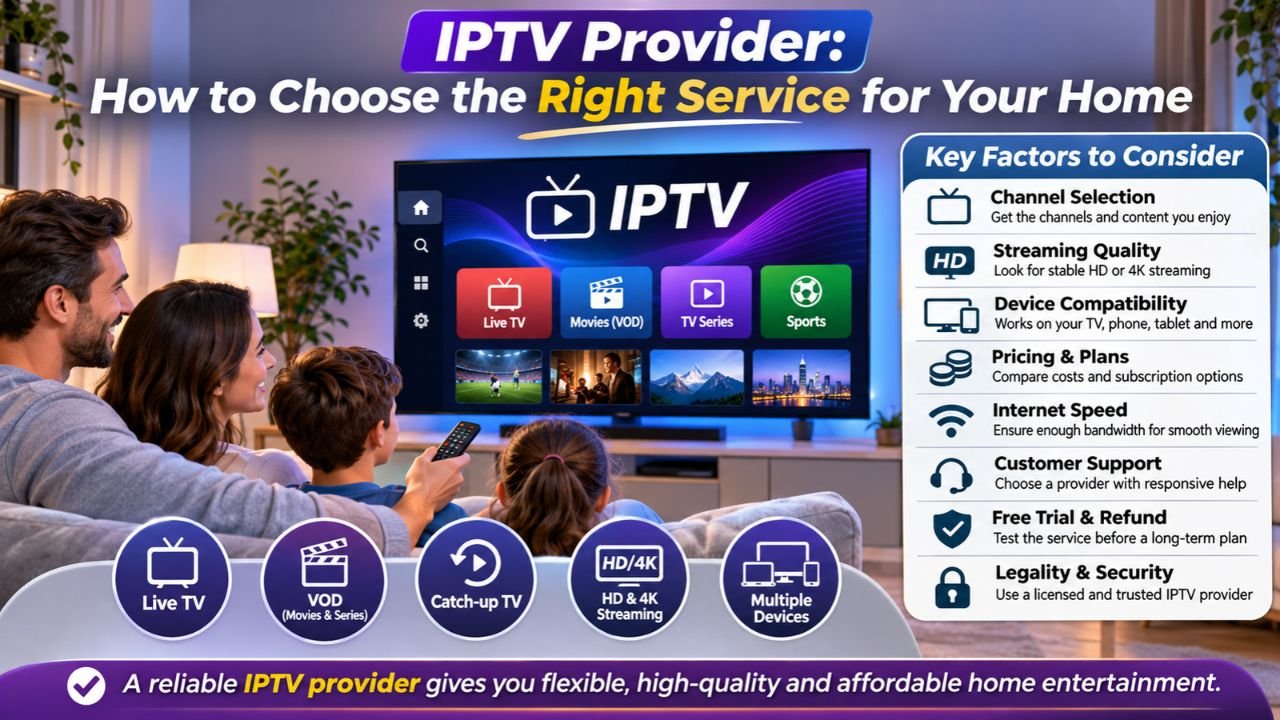
Traditional cable television isn’t the only way to watch your favourite shows anymore. With a reliable internet connection and a good IPTV provider, you can access live television, movies, sports, and entertainment without dealing with complicated cable installations.
But choosing the right service isn’t always straightforward. Some providers offer excellent picture quality but limited channel selections. Others promise thousands of channels yet struggle with buffering during popular sporting events.
The difference between a good and a disappointing IPTV experience often comes down to the provider you choose. Understanding how these services work, what features actually matter, and what potential problems to avoid can save you both money and frustration.
Whether you’re replacing cable television or simply looking for more flexible entertainment options, it helps to know exactly what you’re paying for.
Table of Contents
- What Is an IPTV Provider?
- How Does an IPTV Service Work?
- Different Types of IPTV Services
- IPTV vs Traditional Cable Television
- What Makes a Good IPTV Provider?
- How Much Does an IPTV Subscription Cost?
- Is IPTV Legal and Safe?
- Internet Speed Requirements for IPTV
- Common IPTV Problems and Their Solutions
- How to Choose the Right IPTV Service
- Is IPTV Worth Paying For?
- Final Thoughts
What Is an IPTV Provider?
An IPTV provider is a service that delivers television programming through an internet connection rather than traditional satellite or cable systems. IPTV stands for Internet Protocol Television, a technology that allows viewers to stream video content using internet-based networks.
Instead of receiving television signals through a satellite dish, your device receives digital video data through a network connection.
The concept is fairly simple. You select a channel or programme, and the service delivers the requested content to your device.
Many IPTV services support smart televisions, smartphones, tablets, computers, and compatible streaming devices. This flexibility makes them particularly appealing to households that want entertainment across multiple screens.
Depending on the subscription, viewers may also have access to international channels, recorded programmes, live sports, and on-demand entertainment.
How Does an IPTV Service Work?
IPTV works by converting television content into digital data that can travel across an internet protocol network. When you select something to watch, the provider’s delivery system sends that content to your device.
A compatible application or media player processes the incoming data and displays the video on your screen.
Think about switching between channels during a football match. Instead of relying on a conventional broadcast signal, your device requests the appropriate video stream from the service.
Behind the scenes, servers, video compression technologies, and network infrastructure work together to keep playback running smoothly.
A well-managed service can deliver excellent picture quality with minimal interruptions. However, overloaded servers or unstable internet connections may result in buffering, delayed playback, or reduced video quality.
Different Types of IPTV Services
IPTV isn’t limited to watching live television. Several delivery formats give viewers greater control over their entertainment experience.
Live Television
Live IPTV allows you to watch television channels as programmes are being broadcast. It’s particularly useful for sporting events, breaking news, and live entertainment.
The experience resembles traditional television, except the content travels through an internet-based network.
Video on Demand
Video on demand, commonly called VOD, lets viewers select movies, television series, documentaries, and other programmes whenever they want.
There’s no need to follow a broadcasting schedule. You can start a film after dinner, pause it halfway through, and finish watching the following evening if the service supports playback resumption.
Time-Shifted Television
Time-shifted television allows viewers to access previously broadcast programmes within a specified period.
Catch-up television is a common example. If you miss your favourite programme because you’re working late, you may be able to watch it the next morning without recording it manually.
IPTV vs Traditional Cable Television
Cable television has served households reliably for decades, but internet-based entertainment offers greater flexibility in many situations.
Traditional cable packages often require dedicated equipment and may include channels you rarely watch. IPTV subscriptions sometimes provide more flexible packages and wider device compatibility.
| Feature | IPTV | Traditional Cable |
| Delivery method | Internet protocol network | Cable network |
| Device compatibility | Multiple compatible devices | Mainly televisions and cable equipment |
| Content flexibility | Often extensive | Package dependent |
| Installation | Usually straightforward | May require professional installation |
| Internet dependency | Yes | Generally no |
| On-demand content | Often available | Provider dependent |
| Pricing | Subscription dependent | Package dependent |
IPTV isn’t automatically better for everyone. Someone living in an area with unreliable broadband might find traditional cable more dependable.
The better option depends on your viewing habits, available infrastructure, and budget.
What Makes a Good IPTV Provider?
A large channel library looks impressive, but it doesn’t necessarily guarantee a satisfying experience. Several practical features deserve closer attention.
Streaming quality should be consistent, particularly during busy evening hours. HD and 4K support are useful, provided the content, device, and connection can handle those resolutions.
Channel availability matters just as much. A package containing thousands of channels offers little value if it doesn’t include the programmes your family actually watches.
Device compatibility is another consideration. Before purchasing a subscription, confirm that the service supports your television, streaming device, or preferred operating system.
Reliable customer support can also make a noticeable difference. When something stops working on a Friday evening, having access to helpful technical assistance becomes more important than an impressive channel count.
Look for transparent subscription terms, clear cancellation policies, and a professionally maintained platform.
How Much Does an IPTV Subscription Cost?
IPTV pricing varies considerably depending on content licensing, available channels, streaming quality, geographical location, and additional features.
Basic subscriptions may cost relatively little, while premium services containing licensed sports channels, movies, and exclusive entertainment can be considerably more expensive.
Monthly subscriptions are often a sensible starting point because they allow you to evaluate performance without making a long-term financial commitment.
Imagine purchasing an annual subscription because it appears cheaper, only to discover that the service frequently buffers during your favourite matches. The initial savings suddenly become less attractive.
Check whether the subscription includes additional charges for simultaneous streaming, premium channels, or extra devices.
A reasonably priced service that performs consistently is often better value than the cheapest available package.
Is IPTV Legal and Safe?
IPTV technology itself is completely legitimate. Many established broadcasters and entertainment companies use internet protocol networks to distribute television content.
The legal issue arises when a service distributes copyrighted material without obtaining the appropriate broadcasting rights.
A legitimate IPTV provider should have permission to distribute the content included in its subscription.
Be cautious about platforms offering enormous collections of premium sports channels, recently released films, and international television packages at unrealistically low prices.
Unlicensed services may also expose users to security risks, unexpected shutdowns, unreliable payment systems, and potential legal consequences depending on local laws.
Choose providers with transparent business information, secure payment options, clear privacy policies, and established distribution rights. Avoid installing applications from suspicious or unverified sources.
Internet Speed Requirements for IPTV
Your internet connection plays a major role in determining streaming performance. Even a reliable television service can struggle when your home network is congested.
The following speeds are reasonable general targets for a single video stream.
| Streaming Quality | Suggested Internet Speed |
| Standard Definition (SD) | 3–5 Mbps |
| High Definition (HD) | 5–10 Mbps |
| Full HD (1080p) | 10–15 Mbps |
| Ultra HD (4K) | 25 Mbps or more |
Actual requirements vary depending on video compression, streaming technology, and provider recommendations.
If multiple family members are watching videos, downloading files, or playing online games simultaneously, you’ll need additional bandwidth.
An Ethernet connection can provide more consistent performance than Wi-Fi. If a wired connection isn’t practical, positioning your router closer to your television may help improve streaming stability.
Common IPTV Problems and Their Solutions
Buffering is probably the most frustrating problem viewers encounter. It often happens when the video stream cannot deliver data quickly enough for uninterrupted playback.
Start by checking your internet speed, restarting your router, and closing unnecessary applications. Reducing video resolution temporarily may also help identify whether bandwidth is the problem.
Sometimes, however, the provider’s servers are responsible.
Channel loading errors can result from temporary service outages, expired subscriptions, outdated applications, or incorrect account settings.
Audio and video synchronisation problems may be resolved by restarting playback or updating your media player.
If problems occur regularly across different devices and stable internet connections, your provider may not be delivering adequate service quality. Contact customer support before renewing your subscription.
How to Choose the Right IPTV Service
Start with your actual viewing habits rather than comparing services purely by their advertised features.
Do you mostly watch live sports? Are international news channels important to you? Does your family prefer movies and television series?
These questions help narrow down your options quickly.
Before subscribing, check the following:
- Content licensing and provider reputation.
- Availability of your favourite television channels.
- Streaming quality and server reliability.
- Compatibility with your existing devices.
- Subscription costs and cancellation policies.
- Customer support availability.
- Simultaneous streaming limitations.
If a legitimate provider offers a free trial, use it during different times of the day. Testing a service during busy evening hours can reveal performance issues that might not appear during quieter periods.
Avoid rushing into long-term subscriptions simply because a promotional offer looks attractive.
Is IPTV Worth Paying For?
For many households, IPTV can be a practical alternative to conventional television packages.
The ability to access entertainment across multiple devices, watch programmes on demand, and choose suitable subscription packages makes internet-based television appealing.
However, the experience depends heavily on service quality and internet reliability.
Someone who travels frequently may appreciate watching compatible content on a tablet or smartphone. A family with different entertainment preferences might benefit from multiple simultaneous streams.
On the other hand, households with unstable broadband or limited data allowances may encounter difficulties.
IPTV is worth considering when it genuinely improves your viewing experience without creating unnecessary expenses or technical problems.
Final Thoughts
Choosing an IPTV provider shouldn’t be about finding the biggest channel collection or the lowest subscription price. It’s about finding a dependable, legitimate service that fits your everyday entertainment needs.
Take time to compare streaming performance, content availability, device compatibility, and subscription conditions. Test the service when possible, and avoid committing to lengthy subscriptions before you’re satisfied with its quality.
A good television service should make entertainment easier, not leave you troubleshooting buffering problems every evening. Prioritise reliability, security, and genuine value, and you’ll have a much better chance of finding an IPTV service worth keeping.