
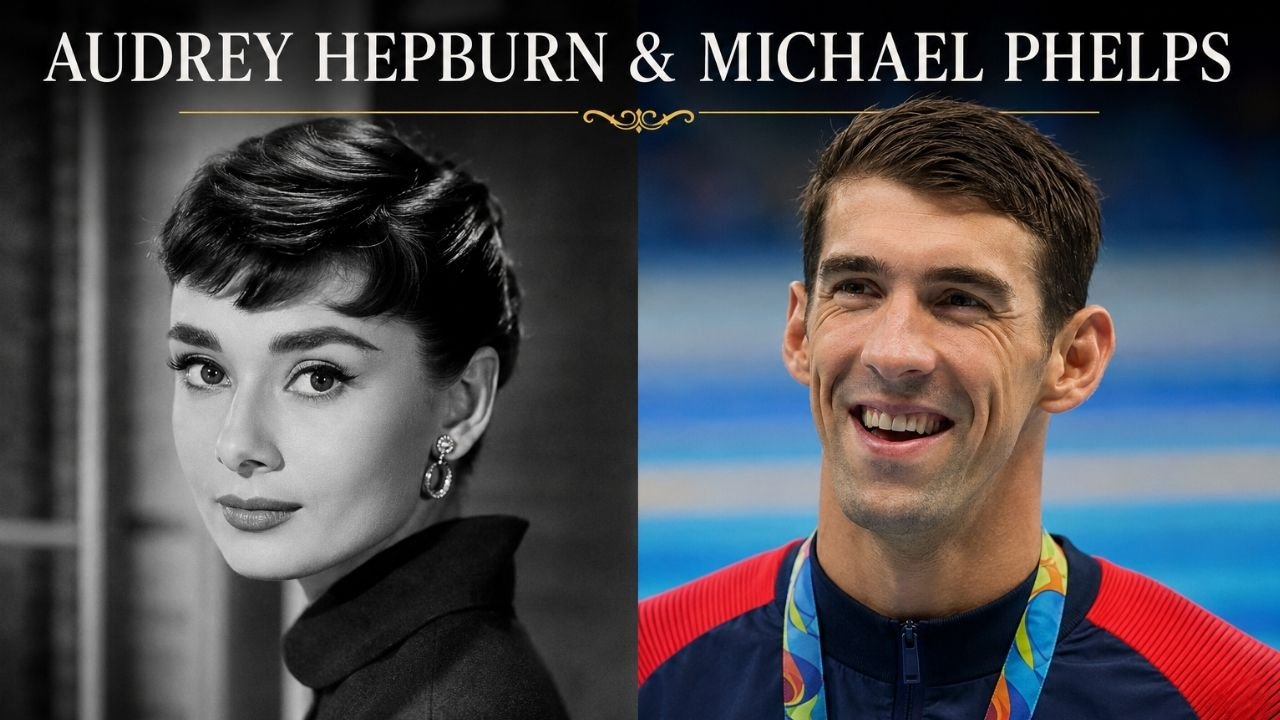
Audrey Hepburn and Michael Phelps are names associated with two very different areas of public life. Hepburn became one of the most recognizable actresses and humanitarian figures of the 20th century, while Phelps built an extraordinary legacy as an Olympic swimmer. Because both achieved international fame and became symbols of excellence in their respective fields, their names sometimes appear together in online searches. However, there is no well-documented personal, family, or professional relationship between them.
The most interesting way to understand the connection is therefore not to look for a relationship that did not exist, but to examine what these two remarkable people represented. Hepburn’s legacy developed through cinema, fashion, elegance, and humanitarian service, while Phelps’ reputation was built through discipline, competition, records, and Olympic achievement. Their stories belong to different generations, yet both demonstrate how an individual can become much larger than the profession that first made them famous.
Quick Bio: Audrey Hepburn and Michael Phelps
| Detail | Audrey Hepburn | Michael Phelps |
|---|---|---|
| Full name | Audrey Kathleen Hepburn | Michael Fred Phelps II |
| Born | May 4, 1929 | June 30, 1985 |
| Birthplace | Brussels, Belgium | Baltimore, Maryland, U.S. |
| Profession | Actress and humanitarian | Competitive swimmer |
| Best known for | Roman Holiday, Breakfast at Tiffany’s, My Fair Lady | Olympic swimming career |
| Major achievement | Academy Award-winning actress | 28 Olympic medals |
| Humanitarian connection | UNICEF Goodwill Ambassador | Athlete and philanthropic advocate |
| Legacy | Film, fashion and humanitarian work | Olympic swimming and athletic achievement |
Who Was Audrey Hepburn?
Audrey Hepburn emerged as one of Hollywood’s most admired stars during the 1950s and 1960s. Born in Brussels in 1929, she studied ballet before moving toward acting. Her breakthrough came with Roman Holiday, in which she played Princess Anne opposite Gregory Peck.
The performance was a major turning point. Hepburn won the Academy Award for Best Actress for the role, establishing herself as a leading international star. The Academy’s official records confirm her Best Actress victory for Roman Holiday at the 1954 ceremony.
Her career continued with memorable films including Sabrina, Funny Face, Breakfast at Tiffany’s, Charade, My Fair Lady, and Wait Until Dark. She became associated with a distinctive style that combined sophistication with simplicity, and her screen presence helped make her a lasting cultural figure.
Yet focusing only on Hepburn’s acting career leaves out an important part of her story. Her later years were increasingly connected with humanitarian work. In 1988, she became a UNICEF Goodwill Ambassador and traveled to countries affected by poverty, famine, disease, and difficult conditions for children.
According to UNICEF, Hepburn visited projects and communities in places including Ethiopia, Turkey, Venezuela, Ecuador, Guatemala, Honduras, Bangladesh, Thailand, Vietnam, Sudan, Somalia and Kenya. She used her fame to draw attention to children’s needs and continued her work even while seriously ill.
Hepburn died on January 20, 1993, at her home in Switzerland. Her humanitarian contribution became an important part of the legacy she left behind.
Who Is Michael Phelps?
Michael Phelps belongs to a completely different generation. Born in Baltimore in 1985, he became a competitive swimmer at an exceptionally young age and eventually developed into one of the most successful athletes in Olympic history.
Phelps competed at five Olympic Games, beginning with Sydney 2000 and continuing through Athens, Beijing, London and Rio. His Olympic career produced 28 medals, including 23 gold medals, making him the most decorated Olympian in history.
His achievements were not simply the result of natural ability. Phelps became known for intense training, technical precision, competitive focus and an extraordinary ability to perform under pressure. His success helped bring swimming to an enormous worldwide audience.
The scale of his Olympic achievement is particularly striking when viewed across multiple Games. Instead of winning at a single competition and disappearing from the international spotlight, Phelps maintained an elite level over many years. His career became an example of sustained athletic excellence.
Is There a Connection Between Audrey Hepburn and Michael Phelps?
There is no established evidence that Audrey Hepburn and Michael Phelps were relatives, close friends, romantic partners, or professional collaborators.
The timeline itself explains why a meaningful personal relationship would be unlikely. Hepburn was born in 1929, while Phelps was born in 1985, creating a 56-year age difference. Hepburn died in 1993, when Phelps was only eight years old.
Their professional worlds were also entirely separate. Hepburn worked primarily in film and later humanitarian advocacy, while Phelps spent his career in competitive swimming. There is no widely documented film, sporting project, charity campaign, interview, or public appearance that brought the two together.
Therefore, an article about the pair should avoid presenting an imagined relationship as fact. The more useful approach is to explain why two unrelated global personalities can appear together in online searches and what their separate legacies reveal.
Two Different Paths to Global Fame
The strongest similarity between Hepburn and Phelps is not a personal connection but the extraordinary scale of their public recognition.
Hepburn became famous through storytelling and performance. Her appeal was based on acting ability, screen presence, elegance, and the memorable characters she portrayed. Over time, her public identity expanded beyond movies into fashion and humanitarian work.
Phelps achieved fame through measurable sporting performance. Swimming provided an environment in which success could be demonstrated through medals, times, records, and victories. His career represents the competitive side of achievement in a very literal sense.
Their paths show that global influence can be built in very different ways. One person can become iconic through art and cultural influence, while another can reach the same level of recognition through sport and physical achievement.
Audrey Hepburn’s Humanitarian Legacy
One of the most important aspects of Hepburn’s story is the transition from Hollywood celebrity to humanitarian advocate.
UNICEF describes her as a tireless advocate for children’s rights. Her personal memories of receiving food and medical assistance during and after World War II helped shape her commitment to children facing hardship.
She did not simply lend her name to the organization. She traveled extensively, spoke publicly, gave interviews, met communities, and helped draw international attention to humanitarian emergencies. UNICEF records that she continued these activities in 1992 despite being seriously ill.
This part of her life helps explain why Hepburn’s reputation has survived long after her major movie career ended. Her legacy is not limited to the images associated with classic Hollywood. It also includes her willingness to use celebrity status to promote a cause larger than herself.
Michael Phelps and the Meaning of Athletic Legacy
Phelps’ legacy is similarly larger than a collection of medals.
His career illustrates the role of preparation and consistency in elite sport. Olympic competition requires athletes to perform under enormous pressure, often with very small margins separating success from disappointment. Phelps repeatedly managed to perform at the highest level.
His 28 Olympic medals became a defining statistic, but the broader story includes years of training, international competition, personal challenges and the pressure that accompanies extraordinary expectations.
For many sports fans, his name has become synonymous with Olympic swimming. His achievements also helped inspire younger swimmers and contributed to the visibility of the sport around the world.
What Can We Learn From Their Different Stories?
Although Audrey Hepburn and Michael Phelps never became a notable pair in real life, comparing their careers can still be meaningful.
Hepburn demonstrates how cultural influence can continue after an entertainment career has ended. Her films remain widely recognized, while her humanitarian activities added another dimension to her public legacy.
Phelps demonstrates how sustained excellence can transform an athlete into a global symbol. His Olympic record provides a measurable record of achievement, but his influence extends to the people who became interested in swimming because of his success.
Both stories also demonstrate the importance of using public recognition responsibly. Hepburn used her visibility to advocate for children, while Phelps has used his platform in areas connected with swimming, youth and charitable causes.
Why the Audrey Hepburn and Michael Phelps Search Can Be Misleading
Online searches sometimes bring together names that do not have a direct historical connection. When that happens, readers should distinguish between a genuine relationship and an algorithmically generated association.
In this case, the safest conclusion is straightforward: Audrey Hepburn and Michael Phelps were extraordinary figures from different generations and different professional worlds. There is no reliable basis for claiming that they were related or worked together.
That distinction is especially important for biography content. A strong article should answer the reader’s likely question without inventing details simply because a keyword appears in search results.
SEO-Friendly and People-First Coverage
For publishers covering celebrity biographies and comparison topics, accuracy is more valuable than repetition. Google’s current Search guidance explicitly identifies keyword stuffing as spam and also warns against scaled content created primarily to manipulate rankings rather than provide value.
That means a useful article should have a clear purpose, natural language, factual context, original organization, and enough substance to satisfy the reader. Simply repeating a person’s name throughout multiple paragraphs does not make a page more authoritative.
Google’s August 2026 update to its site-reputation policy also emphasizes the importance of avoiding attempts to exploit an established site’s reputation for ranking purposes. For a site such as News Sora, the practical lesson is to publish genuinely useful editorial content rather than producing large numbers of near-identical celebrity pages.
Final Thoughts
Audrey Hepburn and Michael Phelps represent two very different forms of international achievement. Hepburn’s career transformed her from an acclaimed actress into a cultural icon and humanitarian advocate, while Phelps became an Olympic legend through an extraordinary swimming career.
There is no established personal or professional relationship between them, and their names should not be presented as though they shared one. Instead, their appearance together in search queries provides an opportunity to compare two very different journeys to worldwide recognition.
Audrey Hepburn’s enduring appeal comes from her films, style, grace and humanitarian service. Michael Phelps’ legacy rests on determination, competitive excellence and an unprecedented Olympic medal record. Although their lives followed separate paths, both demonstrate how exceptional individuals can leave a lasting mark on global culture.
For readers discovering this topic through search, the most important takeaway is simple: Audrey Hepburn and Michael Phelps were not known as a connected pair; they were independent icons whose remarkable careers unfolded in completely different eras and fields. That factual distinction is what makes their comparison interesting without creating a story that the historical record does not support.
For News Sora, this kind of careful, reader-focused coverage offers a stronger foundation than sensational claims. Accurate biographies, transparent comparisons and useful context can give readers a reason to stay on the page while helping the publication build a trustworthy editorial identity over time.