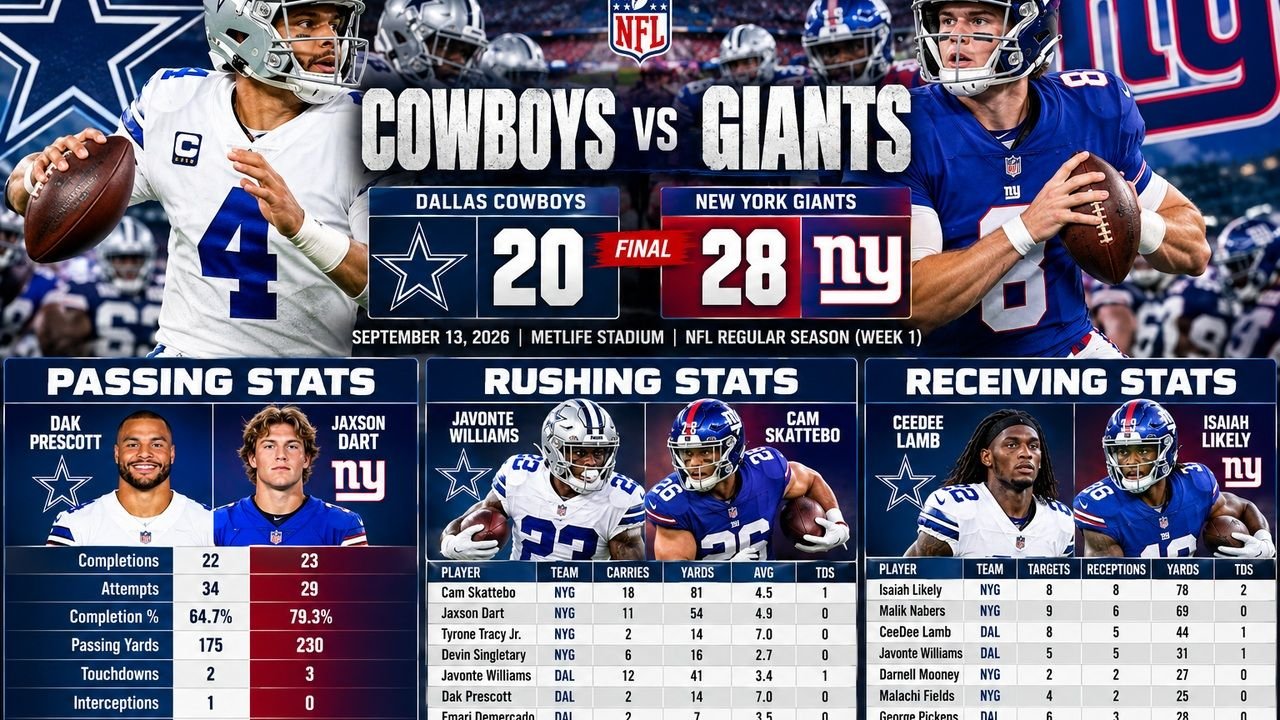
The Dallas Cowboys and New York Giants opened their 2026 NFL regular seasons with a competitive NFC East matchup at MetLife Stadium on September 13, 2026. New York came away with a 28–20 victory, combining an efficient passing performance with a productive rushing attack. The result gave the Giants a winning start to the season, while Dallas was left looking for answers after struggling to contain its division rival.
The game offered several important talking points, including Jaxson Dart’s accuracy, Cam Skattebo’s contribution on the ground, Isaiah Likely’s touchdown receptions, and Dak Prescott’s efforts to keep Dallas in contention. Examining the individual performances alongside the team statistics provides a clearer picture of how the eight-point margin developed.
Quick Match and Player Bio Table
| Detail | Information |
|---|---|
| Match | Dallas Cowboys vs New York Giants |
| Date | September 13, 2026 |
| Competition | NFL regular season, Week 1 |
| Venue | MetLife Stadium |
| Final score | Cowboys 20–28 Giants |
| Winning team | New York Giants |
| Cowboys quarterback | Dak Prescott |
| Giants quarterback | Jaxson Dart |
| Leading Giants rusher | Cam Skattebo |
| Standout Giants receiver | Isaiah Likely |
| Leading Cowboys receiver by yards | CeeDee Lamb |
Match Overview: How the Giants Beat Dallas
New York won by producing more consistent offense across the four quarters. The Giants finished with 394 total yards, compared with 244 for Dallas, and held possession for 36 minutes and 40 seconds. That difference gave their offense more opportunities to sustain drives and kept the Cowboys from controlling the tempo.
Dallas had moments of promise, particularly when Prescott connected with his receivers in scoring situations. However, the Cowboys did not generate enough overall yardage to match New York’s output. Their defense also struggled to limit the Giants’ combination of designed runs, quarterback mobility, and short-to-intermediate passing plays.
The Giants’ 28–20 victory was not simply the result of one spectacular play. Their balanced attack helped them move the chains, maintain possession, and convert important opportunities into points.
Dak Prescott vs Jaxson Dart: Quarterback Statistics
The quarterback comparison was one of the most revealing parts of the game. Prescott completed 22 of 34 passes for 175 yards, two touchdowns, and one interception. Dart completed 23 of 29 attempts for 230 yards and three touchdowns without throwing an interception.
| Passing statistic | Dak Prescott | Jaxson Dart |
|---|---|---|
| Completions | 22 | 23 |
| Attempts | 34 | 29 |
| Completion percentage | 64.7% | 79.3% |
| Passing yards | 175 | 230 |
| Passing touchdowns | 2 | 3 |
| Interceptions | 1 | 0 |
| Passer rating | 84.8 | 134.2 |
| Rushing yards | 14 | 54 |
Dart’s efficiency was a major difference-maker. He completed nearly four out of every five passes and produced three touchdown throws while avoiding an interception. His 54 rushing yards added another dimension to New York’s offense, forcing Dallas to account for the quarterback as a running threat as well as a passer.
Prescott delivered two touchdown passes, but his 175 passing yards and interception left Dallas with less room for error. Although the Cowboys found ways to score, their quarterback did not match Dart’s overall statistical efficiency on this occasion.
These figures also demonstrate why quarterback analysis should consider more than passing touchdowns alone. Completion percentage, yardage, turnovers, rushing contributions, and the ability to sustain drives all help explain the result.
Cowboys vs Giants Rushing Stats
New York’s ground game helped establish control over the matchup. Cam Skattebo led the Giants with 81 rushing yards on 18 carries, averaging 4.5 yards per attempt. He also scored a rushing touchdown, giving the Giants a dependable option when they needed to advance the ball without relying exclusively on Dart’s arm.
Dart contributed 54 rushing yards on 11 carries. His mobility made the defensive assignment more complicated for Dallas because defenders had to protect against both conventional running plays and the quarterback taking advantage of open space.
On the Cowboys’ side, Javonte Williams recorded 41 rushing yards on 12 carries and scored a rushing touchdown. Prescott added 14 yards on two attempts, while Emari Demercado and Hunter Luepke contributed seven rushing yards apiece.
The individual numbers illustrate the different roles played by the offensive units. Skattebo supplied the Giants with volume and consistency, while Dart added explosive mobility from the quarterback position. Dallas received a useful contribution from Williams, but the team’s overall offensive production remained below New York’s level.
Receiving Leaders and Touchdown Contributions
Isaiah Likely was one of New York’s most effective offensive players. He caught eight passes for 78 yards and two touchdowns, providing Dart with a reliable target in important scoring situations. His two touchdown receptions helped turn the Giants’ passing efficiency into a tangible advantage on the scoreboard.
Malik Nabers also played a significant role, finishing with six receptions for 69 yards. His production helped stretch the defense and gave New York another dependable receiving option beyond Likely.
For Dallas, CeeDee Lamb led the team’s receiving group with five catches for 44 yards and a touchdown. Javonte Williams added five receptions for 31 yards and another touchdown, demonstrating that his contribution extended beyond rushing attempts.
George Pickens recorded three receptions for 28 yards, while Ryan Flournoy added two catches for 22 yards. These contributions gave Prescott several options, but Dallas did not accumulate enough passing yardage to keep pace with New York’s offense.
The receiving statistics highlight a clear contrast. Likely converted his opportunities into multiple touchdowns, Nabers provided additional yardage, and Lamb remained a scoring threat for Dallas. New York’s ability to distribute the ball among its principal targets helped make its passing game difficult to contain.
Team Statistics: Dallas Cowboys vs New York Giants
The team-level numbers explain the outcome more clearly than the final score alone.
| Team statistic | Cowboys | Giants |
|---|---|---|
| Points scored | 20 | 28 |
| Total yards | 244 | 394 |
| Passing yards, net | 175 | 229 |
| Rushing yards, net | 69 | 165 |
| Total plays | 52 | 68 |
| First downs | 21 | 29 |
| Time of possession | 23:20 | 36:40 |
| Third-down conversions | 8 of 11 | 9 of 11 |
| Turnovers | 1 | 1 |
New York’s advantage in total yards was particularly important. The Giants generated 150 more yards than Dallas and ran 16 additional offensive plays. Their possession advantage of 13 minutes and 20 seconds also reduced the time available for the Cowboys to build a comeback.
Both teams recorded a turnover, so the difference cannot be explained simply by Dallas giving the ball away more frequently. Instead, the Giants were more productive with their offensive opportunities and generated greater yardage through both the passing and rushing games.
The third-down figures were relatively close, with both teams converting a high proportion of their attempts. That makes New York’s advantage in total plays, first downs, and yardage especially relevant when assessing the overall performance.
Quarter-by-Quarter Scoring Summary
| Quarter | Dallas Cowboys | New York Giants |
|---|---|---|
| First quarter | 0 | 7 |
| Second quarter | 7 | 7 |
| Third quarter | 7 | 7 |
| Fourth quarter | 6 | 7 |
| Final score | 20 | 28 |
New York scored seven points in each quarter, maintaining a consistent offensive contribution throughout the game. Dallas scored touchdowns in the second and third quarters, then added six points in the fourth. The Cowboys were able to produce scoring plays, but they could not match the Giants’ steady output.
The scoring pattern reinforces the importance of consistency in divisional matchups. A team can remain competitive for long stretches, yet still lose when its opponent repeatedly converts drives into points.
What the Player Stats Reveal About the Game
Three factors stand out from the statistical comparison. First, Dart’s combination of passing efficiency and rushing ability gave New York an advantage at quarterback. His 230 passing yards, three touchdown passes, and 54 rushing yards created multiple ways to move the ball.
Second, Skattebo’s 81 rushing yards and Likely’s two touchdown receptions demonstrated how effectively the Giants combined their ground and aerial attacks. Their contributions complemented Dart’s performance instead of placing the entire offensive burden on one player.
Third, Dallas struggled to match New York’s total offensive output. Prescott threw two touchdowns and Williams contributed both rushing and receiving scores, but the Cowboys finished with considerably fewer yards and less possession time. Those differences limited their ability to control the game.
The result does not, by itself, establish how either team will perform over the entire season. A single game provides useful evidence about execution on that particular day, but injuries, future opponents, tactical adjustments, and changes in form can influence subsequent results.
Frequently Asked Questions
Who won the Dallas Cowboys vs New York Giants game?
The New York Giants defeated the Dallas Cowboys 28–20 on September 13, 2026, at MetLife Stadium.
How many passing yards did Dak Prescott record?
Prescott completed 22 of 34 attempts for 175 passing yards, two touchdowns, and one interception.
What were Jaxson Dart’s stats against the Cowboys?
Dart completed 23 of 29 passes for 230 yards and three touchdowns without an interception. He also recorded 54 rushing yards.
Who led the Giants in rushing?
Cam Skattebo led New York with 81 rushing yards on 18 carries and scored one rushing touchdown.
Who was the leading receiver in the game?
Isaiah Likely led the standout receiving performances with eight catches for 78 yards and two touchdowns. Among the Cowboys, CeeDee Lamb recorded five receptions for 44 yards and one touchdown.
Final Thoughts
The Dallas Cowboys vs New York Giants matchup demonstrated how efficient quarterback play, a productive rushing attack, and reliable receiving targets can combine to produce a winning performance. Jaxson Dart, Cam Skattebo, and Isaiah Likely were central to New York’s victory, while Dak Prescott and CeeDee Lamb provided Dallas with important offensive contributions. The Giants’ 394 total yards and superior possession time ultimately distinguished the two teams. News Sora brings readers this match-focused statistical breakdown to help football fans understand the performances behind the final score and follow the key developments of the NFL season.