
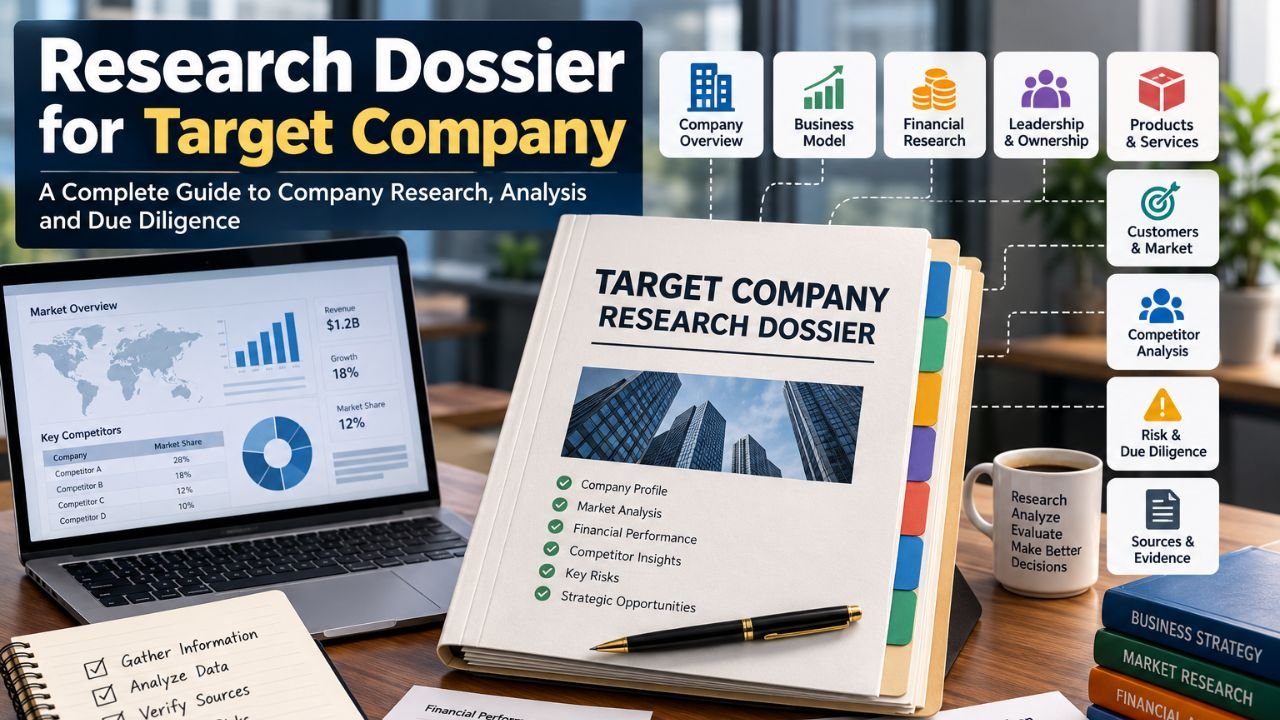
Researching a business properly requires more than collecting its name, website, location, and a few basic facts. A serious company investigation brings together information about the organization, leadership, products, finances, market position, competitors, customers, risks, and recent developments. This is where a research dossier for target company becomes useful.
A well-prepared dossier gives researchers a structured way to understand a business before making an informed decision. It can support investment research, sales preparation, partnership evaluation, competitive intelligence, journalism, recruitment research, or general business analysis. The goal is not simply to collect a large amount of information. The goal is to organize reliable evidence so that important facts can be understood in context.
Quick Research Snapshot
| Area | Information to Collect |
|---|---|
| Company identity | Name, website, headquarters, founding year |
| Industry | Sector, niche, market category |
| Leadership | Founders, executives, board members |
| Business model | Products, services, revenue streams |
| Market | Customers, regions, market position |
| Competitors | Direct and indirect competitors |
| Financials | Revenue, profitability, funding, debt where available |
| Operations | Employees, locations, suppliers, distribution |
| Risks | Legal, financial, operational and market risks |
| Evidence | Company filings, reports, announcements and reputable sources |
What Is a Research Dossier for a Target Company?
A research dossier is a structured collection of information and analysis about a specific organization. Unlike a short company profile, it is designed to provide a broader picture of how the business operates, where it stands in its industry, and what factors may affect its future.
The depth of the dossier depends on its purpose. A sales team may concentrate on decision-makers, products and business needs. An investor may focus more heavily on financial performance, ownership and risk. A journalist may prioritize documented events, public records and statements from company representatives.
A strong dossier therefore begins with a clear research question. Without a defined purpose, research can quickly become a collection of disconnected facts.
Why Target Company Research Matters
Businesses operate within changing markets. Leadership can change, competitors can introduce new products, regulations can evolve, and financial performance can move significantly from one reporting period to another.
A company research dossier helps bring these elements together. Instead of examining isolated facts, the researcher can identify relationships between the company’s strategy, operations, market and performance.
For example, rising revenue may appear positive when viewed alone. However, a deeper review might show that growth came from one temporary contract, a single geographic market, or an acquisition. Context can therefore be just as important as the headline number.
This approach also helps distinguish confirmed information from assumptions. A professional dossier should make it clear when something is documented, estimated, reported by a third party, or still uncertain.
How to Build a Company Research Dossier
The first step is to establish the scope of the investigation. Record the company name, research date, purpose of the research and the questions that need to be answered.
Next, collect foundational information. This includes the organization’s official name, headquarters, founding history, industry, ownership structure, major operating locations and principal activities.
After the basic profile is established, move into the company’s business model. Identify what it sells, who it serves, how it reaches customers and where its revenue comes from. Understanding these elements provides a foundation for evaluating performance and competitive positioning.
The final stages should examine risks, competitors, recent developments and supporting evidence. Each major claim should be traceable to a credible source.
Understanding the Business Model
One of the most important sections of a target company research report is the business model.
Ask straightforward questions. What products or services generate revenue? Who purchases them? Are customers individuals, businesses, governments or a combination? Does the organization depend on subscriptions, transactions, advertising, licensing, physical sales or professional services?
Researchers should also consider the company’s distribution strategy. Some organizations sell directly through their websites or sales teams, while others rely on retailers, distributors, marketplaces or strategic partners.
The objective is to understand how the business creates and captures value. A company can have a popular product but still face challenges if its margins are weak, customer acquisition costs are high, or it depends heavily on one supplier or customer group.
Financial and Performance Research
Financial information can provide important context, but it should always be tied to a specific period.
Depending on what is publicly available, researchers may examine revenue, operating income, net income, cash flow, assets, liabilities, debt, funding, acquisitions and other relevant indicators.
Growth rates can also be useful. Comparing several reporting periods may reveal whether expansion is consistent or driven by an unusual event.
However, numbers should not be presented without context. A percentage increase may look significant while representing a relatively small absolute change. Similarly, strong sales growth does not automatically mean that profitability or cash generation has improved.
A reliable dossier therefore separates reported figures from calculations or interpretations made by the researcher.
Leadership, Ownership and Corporate Structure
People and ownership can have a major influence on a company’s strategy.
Research may cover founders, chief executives, senior management, board members, major shareholders and important leadership changes. For private organizations, some ownership details may not be publicly available, so the dossier should avoid presenting assumptions as facts.
Leadership research should also focus on documented professional backgrounds and responsibilities rather than speculation about personal characteristics.
Corporate structure can be equally important. A company may operate through subsidiaries, parent organizations, regional divisions or separately branded businesses. Understanding these relationships helps prevent inaccurate conclusions about which entity owns a product, brand or operation.
Products, Customers and Market Position
A company cannot be fully understood without examining its products or services and the people who buy them.
List major offerings and identify their intended customer groups. Consider geographic reach, pricing models, distribution channels and notable product changes.
Market research should then place the organization within its broader industry. What alternatives are available to customers? Which businesses compete for the same audience? Are there substitute products that could affect demand?
Competitor research should remain factual. Rather than simply describing one organization as superior or inferior, compare measurable characteristics such as product range, geographic coverage, pricing where publicly available, business model and stated strategic priorities.
Risk and Due Diligence
Risk analysis is another important part of a company dossier.
Potential areas include financial exposure, regulatory requirements, litigation that is publicly documented, cybersecurity incidents, supply-chain dependence, customer concentration, market volatility and operational challenges.
The presence of a risk does not automatically mean that a company is performing poorly. A useful dossier explains the nature of the issue, the available evidence and the period to which the information applies.
Researchers should also distinguish between an established event and an allegation. Reputable reporting, official filings and primary documents are particularly valuable when researching sensitive claims.
Choosing Reliable Research Sources
The quality of a dossier depends heavily on the quality of its evidence.
Useful sources can include company filings, official announcements, investor materials, government databases, regulatory records, reputable business publications and industry organizations. Company websites are useful for understanding how an organization describes itself, but independent sources can provide additional context.
Dates matter. A company profile from several years ago may no longer accurately describe its leadership, products, ownership or market position.
Researchers should therefore record publication dates and, where relevant, the date when the underlying event occurred. Keeping source notes during the research process also makes later fact-checking easier.
Google Search and Safe SEO Considerations in 2026
Publishing a company-research article also requires attention to current search-quality principles. Google reported several major ranking events during 2026, including March and May core updates and spam updates in March, June and August.
The practical lesson for publishers is not to chase every algorithm change with artificial optimization. Instead, content should be genuinely useful to readers.
Google’s current spam guidance specifically addresses scaled content abuse. Creating large quantities of pages that provide little original value, stitching together information from other pages, or producing keyword-heavy pages primarily to influence rankings can create search-quality problems.
For a research article, this means adding genuine value. Explain concepts clearly, organize information logically, distinguish facts from analysis, and avoid creating dozens of nearly identical pages simply by changing a company name.
Google also continues to emphasize people-first content. If AI or other tools are used during research or drafting, the finished article should still be checked, fact-checked and improved by a human. Automated assistance should not become an excuse for publishing repetitive or unsupported material.
Yoast’s SEO guidance points in a similar direction: use the focus keyphrase where it makes sense, maintain readability, use related terminology naturally and avoid excessive repetition. The purpose of optimization should be to help readers understand the subject, not to make the article sound artificially optimized.
Common Mistakes to Avoid
One common mistake is relying on a single source. Another is mixing historical information with current facts without identifying the dates.
Keyword stuffing is another problem. Repeating the same phrase in every heading and paragraph can make an article difficult to read and does not create additional value.
Researchers should also avoid presenting estimates as confirmed figures, copying large sections from other publications, or making unsupported claims about a company’s performance.
A better approach is to use original organization and explanation. Even when the underlying facts are publicly available, the article can provide value by connecting those facts, explaining terminology and showing readers how to interpret the information.
Final Thoughts
A research dossier for target company should function as a practical evidence-based profile rather than a collection of copied facts. The strongest dossiers combine company background, business-model research, financial information, leadership details, market context, competitors, risks and source verification.
For publishers, the same principle applies to the article itself. Current Google guidance places strong emphasis on useful, reliable, people-first information rather than content created mainly to capture search traffic. A carefully researched article with natural keyword coverage, clear headings and meaningful context is more appropriate for long-term search visibility than a page built around repetition.
For readers of News Sora, understanding this research process can make company information easier to evaluate. Whether the goal is business research, competitive analysis, investment preparation or general knowledge, a structured dossier provides a practical framework for separating useful evidence from assumptions and outdated information.