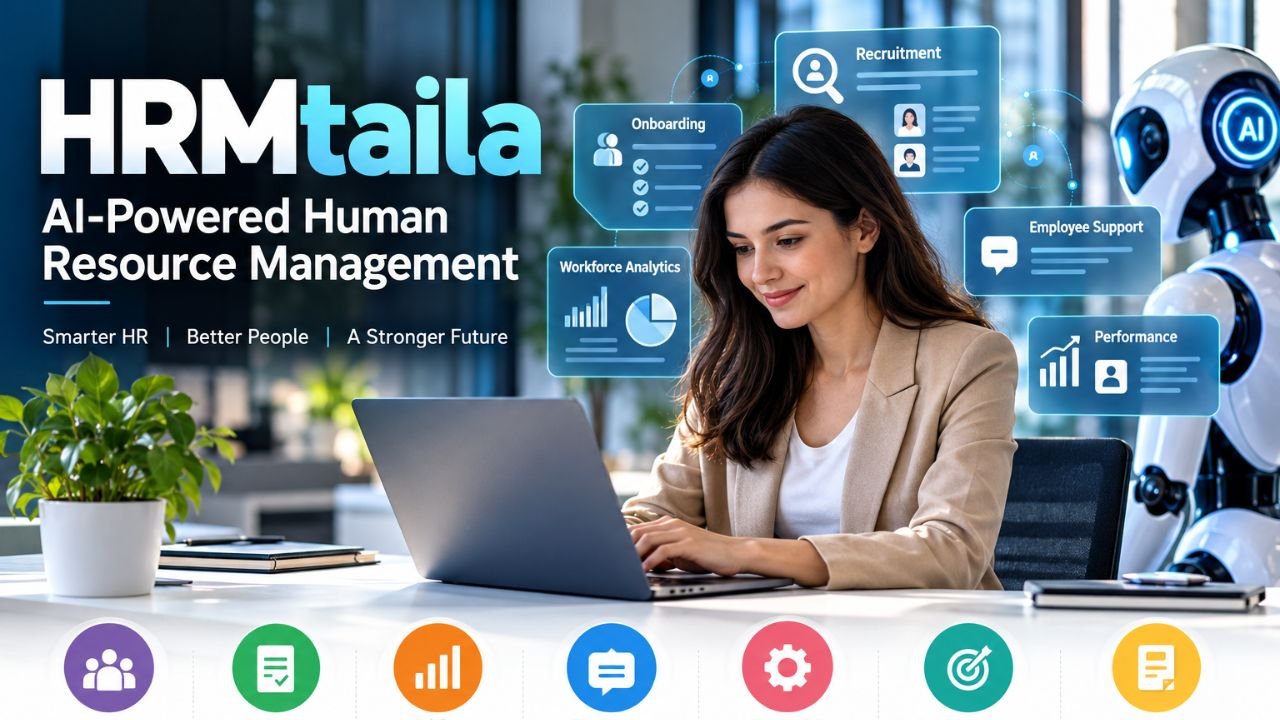
HRMtaila is an emerging term that has recently appeared in online technology and business discussions. Unlike familiar HR software brands with established companies, product pages, documentation, and long histories, HRMtaila does not currently have one universally confirmed identity. Recent articles mainly associate the term with artificial intelligence, human resource management, automation, workforce analytics, employee support, and digital workplace technology.
That distinction is important for anyone researching the keyword. Rather than treating HRMtaila as a confirmed standalone platform, it is more accurate to examine the idea behind the term and its connection with the wider growth of AI in human resources. This approach also helps separate documented information from assumptions about an emerging keyword.
Quick HRMtaila Bio
| Detail | Information |
|---|---|
| Name | HRMtaila |
| Common interpretation | AI-assisted human resource management |
| Main field | Human resources and workplace technology |
| AI connection | Automation, analysis and employee support |
| Possible applications | Recruitment, onboarding, reporting and workforce management |
| Confirmed standalone software | Not clearly established |
| Official creator | Not publicly confirmed |
| Exact origin of the name | Unclear |
| Main audience | HR teams, managers and organizations |
| Current status | Emerging online term |
What Is HRMtaila?
HRMtaila can currently be understood as an emerging label connected with the use of artificial intelligence and digital technology in human resource management. Recent online coverage uses the term when discussing ways technology could make everyday HR processes more organized, automated, and data-driven.
Human resource departments already handle a wide range of responsibilities. Recruitment, employee records, onboarding, training, attendance, workplace policies, performance information, payroll administration, and employee communication can all generate substantial amounts of repetitive work. Digital systems can help organize these activities, while AI can potentially assist with tasks involving information processing and analysis.
The important distinction is that this broader technology concept should not automatically be presented as a particular commercial product. Current evidence does not establish HRMtaila as a widely recognized software brand with a confirmed developer, public pricing structure, or standardized feature set. That makes careful wording especially important when discussing the keyword.
What Does the Name HRMtaila Mean?
The first part of the term, “HRM,” naturally resembles the widely used abbreviation for Human Resource Management. The meaning of “taila,” however, has not been clearly documented by a reliable primary source.
Some online articles speculate about possible interpretations, but speculation should not be presented as established fact. The term may have been created as a technology-oriented name, an online keyword, or a label that developed through recent publishing and search activity.
For readers, the practical meaning is therefore more useful than an unsupported explanation of its name. Current coverage places HRMtaila within discussions about intelligent HR systems and the increasing role of AI in workplace administration.
How HRMtaila Relates to Artificial Intelligence
Artificial intelligence is changing how organizations process information and automate routine activities. In an HR environment, AI can potentially help summarize information, organize large datasets, support communication, identify patterns, and assist employees in finding relevant information.
For example, an organization might use an AI assistant to answer routine questions about workplace procedures or help an HR professional locate information within a large collection of internal documents. Another system might assist with reporting by organizing workforce data into a format that managers can understand more easily.
These examples represent the broader field of AI-powered HR rather than confirmed HRMtaila features. Keeping that distinction clear is essential because the available evidence does not provide a definitive technical specification for HRMtaila.
HRMtaila and Recruitment
Recruitment is one of the areas where automation and AI are increasingly discussed. HR teams can deal with large numbers of applications, interview schedules, candidate communications, job descriptions, and recruitment records.
Technology can assist with administrative parts of that workflow. It may help organize information, automate routine communications, or make it easier for recruiters to manage large volumes of data.
However, recruitment involves people and potentially significant consequences for candidates. Automated systems should therefore not be treated as unquestionable decision-makers. Human review remains important when evaluating qualifications, context, fairness, and suitability.
This is one reason the broader idea behind HRMtaila is better viewed as HR assistance rather than automatic replacement of HR professionals.
Employee Onboarding and Support
The period immediately after someone joins an organization often involves numerous small tasks. New employees may need information about policies, training, workplace procedures, schedules, benefits, internal systems, and documentation.
A well-designed digital HR environment can bring this information together. AI-based assistance could potentially help employees find answers to routine questions without requiring an HR representative to respond manually to every basic request.
This can save time, but accuracy matters. If an AI system provides outdated or incorrect information about an internal policy, the result can be confusing or costly. Organizations therefore need current information sources, appropriate permissions, testing, and human escalation for complex questions.
Workforce Analytics and HR Data
Another important area connected with the HRMtaila concept is workforce analytics.
Organizations generate considerable amounts of HR-related information. This may include attendance records, employee development information, recruitment activity, training completion, staffing levels, and other operational data.
Analytics tools can help turn this information into useful reports and patterns. AI can potentially support this process by identifying relationships or trends within large datasets.
However, HR data is sensitive. A system handling employee information needs appropriate access controls, security practices, data governance, and clear rules about who can use particular information.
The value of automation therefore depends not only on how sophisticated the technology is, but also on how responsibly an organization implements it.
Can HRMtaila Replace Human HR Professionals?
There is currently no basis for claiming that HRMtaila itself replaces HR professionals. More broadly, AI-powered HR technology is better understood as a tool that can support certain administrative and analytical tasks.
Human resources involves communication, judgment, conflict resolution, workplace relationships, leadership, empathy, policy interpretation, and decisions involving individual circumstances. These areas cannot always be reduced to automated instructions.
Technology may be useful for repetitive processes, but important employment decisions still require responsible human oversight.
The most practical model is therefore collaboration: technology handles suitable routine work while HR professionals remain responsible for decisions, relationships, accountability, and situations requiring context.
Potential Benefits of AI-Assisted HR
The broader technology category associated with HRMtaila offers several potential advantages.
Less Repetitive Administration
Automation can reduce the amount of manual work involved in repetitive HR processes. This may give HR teams more time for employee engagement and strategic responsibilities.
Faster Information Access
Digital systems can make workplace information easier to organize and retrieve, particularly when employees need answers to routine questions.
Better Data Organization
Centralized systems can make it easier to manage employee information and prepare reports.
Support for Workforce Planning
Analytics can help organizations understand staffing patterns and operational information, provided that the underlying data is reliable.
More Consistent Workflows
Automated processes can help standardize certain administrative tasks, reducing dependence on manually repeated procedures.
These are potential advantages of AI-assisted human resource technology generally. They should not be presented as guaranteed features or results of a specific HRMtaila product.
Challenges and Risks
Technology does not automatically make HR better. Implementation introduces its own challenges.
Data privacy is one of the biggest concerns because HR departments handle personal employee information. Organizations must consider who can access data, how it is stored, and how it is used.
Accuracy is another issue. AI systems can produce incorrect information, especially when they lack access to current organizational policies or reliable source material.
Bias also deserves attention. Automated systems used in employment contexts need careful testing because poor data or flawed processes can produce unfair outcomes.
Finally, organizations need clear human accountability. Employees should know when they are interacting with an automated system and how to reach a person when a situation cannot be resolved through routine technology.
Is HRMtaila a Real Software Platform?
Based on the currently available information, HRMtaila should not be described confidently as a verified standalone software platform.
Recent articles discussing the term explicitly distinguish it from established HR software products and note the absence of a clearly documented product identity.
There is currently no sufficiently established public evidence in the researched material for confidently stating a specific HRMtaila company, founder, headquarters, pricing model, official application, or fixed list of technical features.
That does not necessarily mean the term has no future significance. New technology names and concepts can develop quickly. However, responsible publishing requires distinguishing what is known from what is merely possible.
Why Accurate Information Matters for HR Technology Content
An article about an emerging keyword can easily become unreliable if every repeated statement on the internet is treated as proof. Several websites may repeat the same description without independently confirming its origin.
For HRMtaila, the safer approach is to explain the current evidence and provide useful context around the broader AI-in-HR field. Readers can then understand both the keyword and the technology landscape without being given invented details.
This approach is also consistent with Google’s current guidance, which emphasizes original, helpful, reliable information rather than content created primarily to attract search traffic. Google specifically recommends adding substantial value when using information from other sources instead of simply rewriting what already exists.
HRMtaila and the Future of Digital HR
The future of HR technology is likely to involve increasingly sophisticated combinations of automation, analytics, artificial intelligence, and traditional HR systems. Organizations are already exploring ways to reduce repetitive work while giving employees faster access to information.
Whether the name HRMtaila eventually becomes associated with a specific product or remains an emerging keyword is not yet clear. What is clearer is the broader trend behind it: businesses are continuing to explore how digital technology can support recruitment, employee services, workforce information, reporting, and administration.
The most useful systems will need to balance efficiency with privacy, accuracy, transparency, security, and human responsibility.
How to Approach HRMtaila Safely
Anyone researching or writing about HRMtaila should verify the identity of any product or company before making specific claims. A genuine software platform should normally have identifiable ownership, official documentation, product information, terms of service, and other evidence that can be independently checked.
Until stronger primary evidence appears, describing HRMtaila as an emerging term associated with AI-assisted human resource management is more accurate than presenting it as an established software company or technology standard.
For publishers, this distinction is particularly valuable. Google says its systems are designed to prioritize helpful, reliable, people-first content and warns against scaled content that exists primarily to manipulate search rankings. Its spam policies specifically identify large volumes of unoriginal content, scraping, and automatically generated pages that provide little user value as problematic practices.
Google Search and 2026 Content Safety Considerations
Google’s Search Status Dashboard records several major ranking events during 2026, including a March spam update, March core update, May core update, June spam update, and August spam update.
The March and June spam updates were global and applied across languages. Google also updated its site reputation policy in August 2026, clarifying how the policy is enforced in the European Economic Area.
For a site publishing articles such as this one, there is no guaranteed formula that prevents ranking changes after an algorithm update. The safer long-term strategy is to publish genuinely useful material, avoid copying other websites, avoid excessive keyword repetition, maintain accurate claims, use descriptive titles, provide clear authorship where appropriate, and ensure that the site has a clear purpose.
Google’s own guidance also makes an important point: there is no preferred article word count. A page should be as long as necessary to satisfy the reader rather than being expanded simply to reach a target number of words.
For HRMtaila specifically, that means explaining the uncertainty surrounding the term is more valuable than filling the page with repeated variations of the keyword.
Final Thoughts on HRMtaila
HRMtaila is currently best understood as an emerging online term associated with AI-assisted human resource management rather than a definitively established software brand. Its surrounding discussion covers automation, recruitment support, employee assistance, workforce analytics, digital records, reporting, and other areas of modern HR technology.
The exact origin of the name and the identity of any official organization behind it remain unclear in the currently available evidence. That uncertainty should be stated openly rather than replaced with assumptions. As AI continues to become part of workplace technology, the ideas associated with HRMtaila may become more clearly defined over time.
News Sora can use this topic as an informative technology and business article by focusing on verified information, explaining the wider AI-in-HR landscape, and clearly separating established facts from emerging interpretations. This approach gives readers useful context while keeping the coverage transparent, natural, and responsible.