
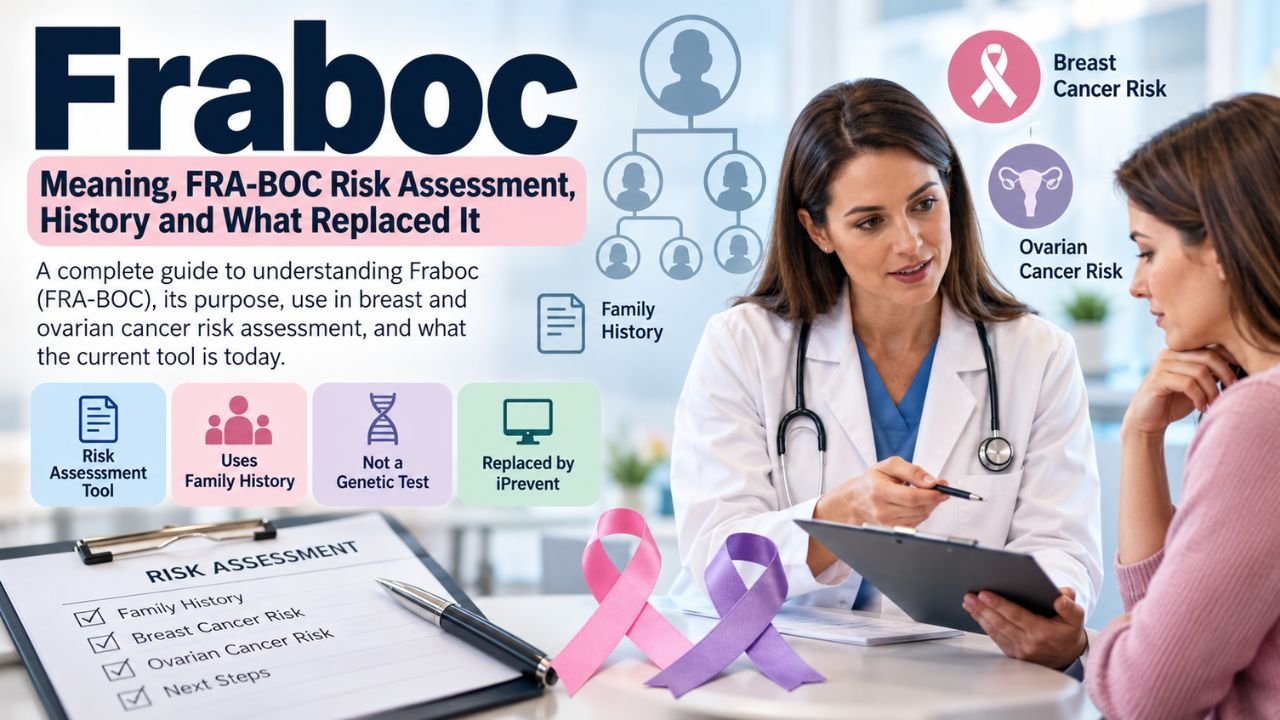
The term fraboc can be confusing because it does not refer to a person, medicine, disease, or single modern technology in its best-documented use. In the Australian healthcare context, FRABOC or FRA-BOC refers to Familial Risk Assessment – Breast and Ovarian Cancer, an online clinical tool that was developed to help health professionals assess breast and ovarian cancer risk using information about a patient’s family history.
Although the original tool is no longer available through the Cancer Australia website, the term can still appear in older medical documents, professional resources and online searches. Current Australian guidance points healthcare professionals toward newer approaches, including the iPrevent tool for breast cancer risk assessment.
Quick Facts About Fraboc
| Detail | Information |
|---|---|
| Established name | Familial Risk Assessment – Breast and Ovarian Cancer |
| Common forms | FRA-BOC, FRABOC |
| Type | Clinical risk-assessment tool |
| Main area | Breast and ovarian cancer |
| Primary users | Healthcare professionals |
| Main information used | Family and cancer history |
| Diagnosis tool | No |
| Genetic test | No |
| Current availability | No longer available through Cancer Australia |
| Current breast-risk alternative | iPrevent |
What Does Fraboc Mean?
FRABOC is an abbreviation for Familial Risk Assessment – Breast and Ovarian Cancer. The name describes its purpose: helping clinicians consider whether a person’s family history may indicate an increased risk of breast or ovarian cancer.
The tool was developed within Australia’s cancer-care information system and was intended for professional rather than general consumer use. Cancer Australia describes FRA-BOC as an online tool for health professionals such as general practitioners and nurses. Its purpose was to assess a patient’s risk of developing breast and ovarian cancer based on family history.
This distinction is important because the word can easily be misunderstood. FRABOC was not itself a cancer diagnosis, treatment, medication or laboratory test. It was a structured way of considering familial risk.
Why Family History Matters in Cancer Risk Assessment
Family history can provide important information when healthcare professionals assess the possibility of inherited or familial cancer risk. Details such as which relatives developed cancer, the type of cancer involved and the age at diagnosis can help create a clearer picture of patterns within a family.
A family history does not automatically mean that an individual will develop cancer. Many people with relatives who have had cancer will never develop the disease themselves, while people without an obvious family history can still develop cancer.
The value of a structured assessment is therefore not simply to count relatives with cancer. Instead, healthcare professionals consider the overall pattern and determine whether additional assessment, screening or specialist advice may be appropriate.
Fraboc and Breast Cancer Risk
Breast cancer was one of the central areas covered by FRA-BOC. Family history can be particularly relevant when several relatives have experienced breast cancer or when cancer has occurred at relatively young ages.
Modern breast cancer risk assessment can involve several factors rather than family history alone. Depending on the person and clinical circumstances, healthcare professionals may consider personal medical history, reproductive factors, previous breast findings, family history and other established risk factors.
BreastScreen Queensland currently describes risk categories in relation to population risk and directs healthcare professionals toward iPrevent for breast cancer risk assessment. Its guidance specifically states that FRA-BOC is no longer available on the Cancer Australia website and has been replaced by iPrevent.
Fraboc and Ovarian Cancer Risk
The second major component of FRA-BOC was ovarian cancer risk. Family patterns involving breast and ovarian cancer can sometimes raise questions about inherited cancer susceptibility.
Certain inherited genetic variants, including changes involving genes such as BRCA1 and BRCA2, can be associated with increased risks for particular cancers. However, a family-history assessment and genetic testing are not the same thing.
A clinician may use family history to determine whether a person should receive further evaluation. Where appropriate, genetic counselling or testing can then be considered based on the individual’s circumstances and established clinical criteria.
Was Fraboc a Genetic Test?
No. This is one of the most important points to understand when researching FRABOC.
FRA-BOC was a risk-assessment tool, not a laboratory genetic test. Its purpose was to help health professionals evaluate familial risk from information supplied about the patient’s family history.
Genetic testing works differently. It examines a person’s genetic material for specific variants or changes. Cancer Australia has separately discussed genetic testing in the context of familial cancer risk, including circumstances involving hereditary cancer syndromes.
Therefore, seeing the term FRA-BOC in an older medical resource should not be interpreted as evidence that someone underwent genetic testing.
Is Fraboc Still Available?
The original FRA-BOC tool is no longer available on the Cancer Australia website. Cancer Australia currently describes the former tool as no longer available and points users toward more up-to-date approaches to breast cancer risk assessment.
BreastScreen Queensland gives the same important update and specifically identifies iPrevent as the replacement for FRA-BOC in breast cancer risk assessment.
This means that people searching for “fraboc” today may be looking for a tool that was historically used in Australia but has since been superseded.
What Replaced Fraboc?
For breast cancer risk assessment, iPrevent is the key modern term associated with the replacement of FRA-BOC.
The change reflects the broader evolution of clinical risk assessment. Digital tools can be updated as evidence, clinical recommendations and risk-management approaches develop. A newer tool may therefore provide a more current framework than an older system.
However, people should not treat an online risk tool as a substitute for individual medical advice. A calculated risk estimate is useful only when it is interpreted in the appropriate clinical context.
Fraboc, Family History and Genetic Counselling
When a family appears to have a notable pattern of breast or ovarian cancer, healthcare professionals may recommend additional assessment. Genetic counselling can be useful because it provides an opportunity to discuss the family history, possible inherited risk, potential benefits and limitations of genetic testing, and what results could mean for relatives.
The purpose of this process is not to predict with certainty whether a person will develop cancer. Rather, it helps healthcare professionals and patients make informed decisions about appropriate risk management.
Older Cancer Australia material describing familial aspects of breast and ovarian cancer also emphasized the role of family history in estimating risk and noted that genetic testing may be considered in some families.
Why the Term Fraboc Still Appears Online
Even though the original tool has been retired, older terminology can remain visible in medical documents, archived resources, professional presentations and search results. This explains why someone may encounter FRABOC while looking for information about familial breast or ovarian cancer risk.
There are also recent blog articles that use “fraboc” to describe supposed digital frameworks, business systems or technology concepts. Those descriptions should be treated carefully because they do not have the same authoritative documentation as the Australian medical meaning.
For an accurate article, the established FRA-BOC definition should be kept separate from newer informal uses of the word. Doing so prevents readers from confusing a former clinical risk-assessment tool with unrelated internet terminology.
Fraboc and Modern Cancer Risk Assessment
The history of FRA-BOC illustrates how healthcare information tools evolve. A clinical resource that was useful in an earlier period may eventually be replaced as newer assessment systems become available.
Today, the focus is less on searching for the old tool and more on obtaining an appropriate current risk assessment. For breast cancer, current Australian guidance identifies iPrevent as a relevant modern resource. For people with significant family histories of breast or ovarian cancer, discussing the history with a qualified healthcare professional remains important.
It is also worth remembering that risk assessment is different from diagnosis. A person can have an elevated estimated risk without having cancer, and a person with an apparently ordinary family history can still develop cancer. Risk tools therefore support clinical decision-making rather than providing certainty about an individual’s future.
How to Research Fraboc Responsibly
Because the term is relatively uncommon, searchers may encounter pages that repeat the same basic description without adding reliable information. A better approach is to check whether claims can be traced to recognized health authorities or established clinical resources.
For this topic, Cancer Australia and BreastScreen Queensland provide particularly useful evidence about the historical FRA-BOC tool and its current status.
For publishers, this also provides an important lesson in creating trustworthy health content. Instead of filling an article with repeated uses of the keyword, the better approach is to explain what the term means, establish its historical context, distinguish it from genetic testing, explain its current availability and identify the modern alternative.
Fraboc in the Context of Google Search in 2026
Google’s current Search guidance emphasizes helpful, reliable and people-first content. Its documentation specifically advises publishers to provide original information, substantial coverage and evidence of expertise rather than creating pages primarily to attract search traffic. It also warns against producing large amounts of low-value content simply to manipulate rankings.
That is especially relevant to a relatively obscure keyword such as fraboc. A useful article should answer the reader’s likely questions instead of repeating the term in every heading or paragraph.
Google’s 2026 Search developments also reinforce the importance of original and useful information. Its February 2026 Discover update emphasized more in-depth, original and timely content while reducing sensational and clickbait material.
Google also introduced an explicit policy against back-button hijacking in 2026, showing that deceptive user experiences remain an important part of its spam enforcement.
In August 2026, Google additionally clarified its site reputation policy and continued to address situations where third-party content is published on established websites primarily to exploit their reputation for Search visibility.
For a website publishing health-related articles, these developments make accuracy, transparency, useful explanations and a good reader experience more important than simply targeting a keyword.
Final Thoughts on Fraboc
Fraboc, more accurately written as FRA-BOC, has a documented Australian medical meaning: Familial Risk Assessment – Breast and Ovarian Cancer. It was an online tool intended for health professionals to assess familial breast and ovarian cancer risk using family-history information. It was not a diagnosis or genetic test, and it is no longer available through Cancer Australia. Current Australian guidance identifies iPrevent as a replacement for breast cancer risk assessment.
For readers searching for this term today, understanding its history is more useful than relying on unsupported definitions circulating across newer blogs. If the search relates to personal or family cancer risk, information from recognized healthcare organizations and advice from an appropriately qualified healthcare professional should take priority over general online explanations.
For News Sora, covering a term such as fraboc responsibly means giving readers context, distinguishing historical information from current guidance, avoiding exaggerated medical claims and explaining the subject in straightforward language. That approach can make an article genuinely useful while also fitting Google’s broader emphasis on helpful, reliable, people-first publishing.