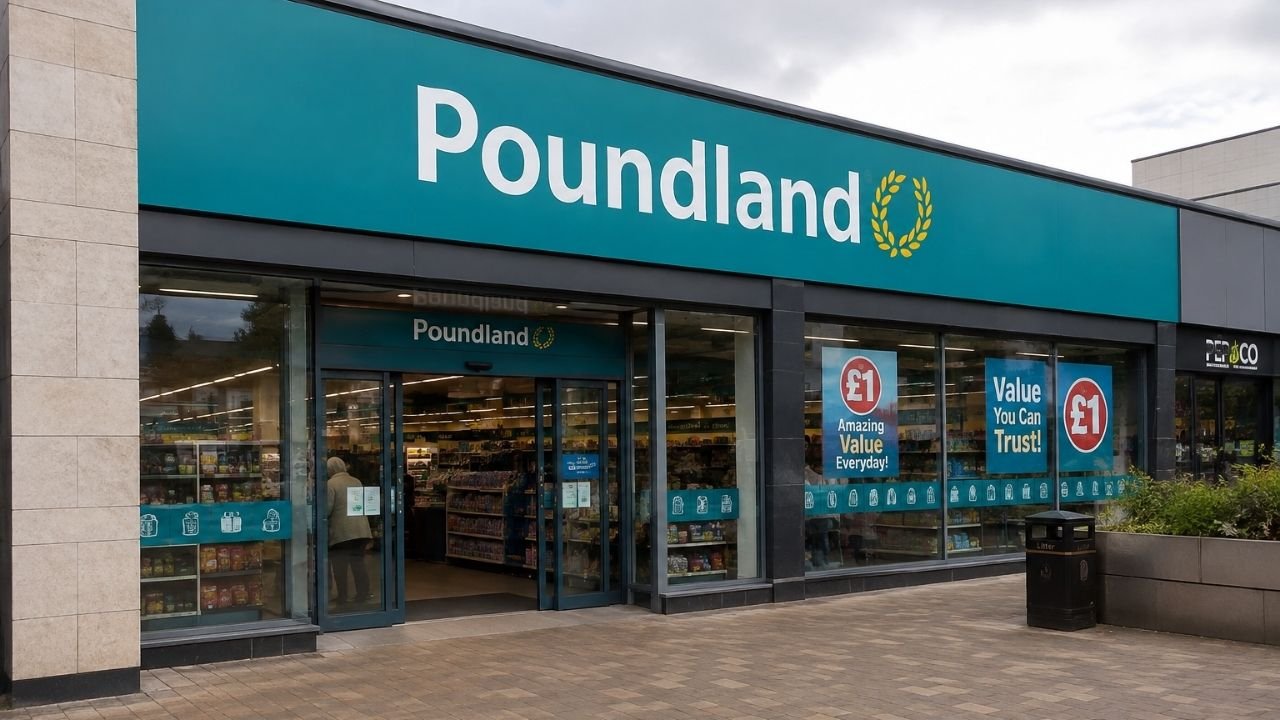
Poundland has reached an important turning point after completing a major restructuring that resulted in the closure of nearly 150 shops across its UK estate. The announcement has generated considerable interest among shoppers searching for information about whether their local Poundland is closing, how many branches remain and what the retailer’s next stage will look like.
The important detail is that Poundland ends store closures does not mean the retailer has permanently promised that no individual shop will ever close again. Instead, the company has finished the large-scale closure programme associated with its restructuring. Poundland ended 2025 with 651 stores, compared with approximately 800 before the overhaul. It also reduced its workforce from around 14,200 employees to approximately 12,000.
For customers, the change represents more than a headline about shops disappearing from high streets. Poundland is attempting to rebuild its business around value, simpler ranges and a stronger proposition across groceries, clothing and general merchandise. The retailer has also begun bringing back PEP&CO clothing while changing its approach to pricing and store operations.
Poundland at a Glance
| Detail | Information |
|---|---|
| Company | Poundland |
| Sector | Discount retail |
| Major restructuring | 2025–2026 |
| Stores before restructuring | About 800 |
| Stores at end of 2025 | 651 |
| Stores removed during restructuring | Nearly 150 |
| Workforce before restructuring | About 14,200 |
| Workforce after restructuring | About 12,000 |
| New owner | Gordon Brothers |
| Acquisition | June 2025 |
| Acquisition price | £1 |
| Main turnaround focus | Value, groceries, clothing and store estate |
Why Did Poundland Close So Many Stores?
The closure programme was part of a much wider financial and operational restructuring. Poundland had been under significant pressure before Gordon Brothers acquired the retailer for £1 in June 2025. The new ownership structure was followed by a plan designed to reduce costs, simplify operations and concentrate resources on the parts of the business considered most important to its future.
The restructuring did not involve stores alone. Poundland also changed its distribution operation, with two of its four warehouses affected, while its customer service operation in Walsall was reorganised. The scale of the changes illustrates why the closure announcement should be understood as one element of a broader turnaround rather than as an isolated decision about individual high-street shops.
The retailer ultimately closed nearly 150 locations. That took the estate from roughly 800 stores to 651 by the end of 2025. At the same time, around 2,200 jobs were lost as the business reduced its workforce and changed how it operated.
For a discount retailer with a large physical presence, reducing the number of shops can be a difficult but significant way of lowering fixed costs. Rent, staffing, utilities, maintenance and other property expenses can make weaker locations difficult to justify, particularly when customers have more options for buying low-cost products.
What Does “Poundland Ends Store Closures” Actually Mean?
This is where the wording matters.
When Poundland announced the end of its restructuring-related closure programme in January 2026, it was saying that the large-scale programme had finished. It was not saying that every store would remain open indefinitely.
Poundland stated that future closures could still occur as a consequence of ordinary lease events. That means a particular branch could potentially close if its lease expires, if new terms cannot be agreed or if circumstances surrounding an individual property change.
That distinction is important for shoppers. Someone seeing a headline saying that Poundland has ended store closures should not automatically assume that every existing branch is guaranteed to remain open permanently.
Recent events in 2026 demonstrate why this qualification matters. Poundland has continued to assess individual properties while also moving in the opposite direction by reopening a former location at Lakeside Shopping Centre in August 2026. The Lakeside reopening came after the previous branch had been closed during the company’s nationwide downsizing programme.
The picture is therefore more nuanced than simply “closing stores” or “saving stores.” Poundland is reshaping its network.
A Smaller Store Network Could Mean a More Focused Business
One of the clearest consequences of the restructuring is the size of the remaining estate. With 651 locations at the end of 2025, Poundland now operates a considerably smaller network than it did before the turnaround began.
A smaller estate can give a retailer an opportunity to concentrate investment on locations with stronger prospects. It may also allow management to put more attention into product availability, store standards and customer experience.
For shoppers, however, there is an obvious downside. When a local branch disappears, customers may have to travel further to reach another store. This can be particularly significant in smaller towns where discount retailers are an important part of the local high street.
That is why individual closures often attract strong community reactions even when the company’s wider strategy is understandable from a business perspective.
Poundland Is Returning to Its Value Roots
Another major part of the turnaround is a renewed emphasis on Poundland’s traditional value proposition.
The company said around 60% of its grocery products had returned to the £1 price point, reflecting an effort to make its pricing easier for customers to understand. Poundland also reported a 9% increase in like-for-like unit volumes across revamped fast-moving consumer goods ranges, while wider business volumes increased by 2%.
This matters because Poundland’s identity has historically been closely associated with simple, low-cost shopping. As prices increased across the retail sector, the traditional expectation that everything would cost £1 became less practical.
The retailer is now attempting to balance modern retail economics with the simplicity that made the brand popular.
The strategy is not necessarily about making every item £1. Instead, it is about making the overall proposition feel clearly valuable and straightforward.
PEP&CO Clothing Is Part of the Recovery Plan
Poundland has also been bringing back its PEP&CO clothing range as part of its effort to rebuild its general merchandise offer.
The clothing relaunch is significant because apparel had previously been an important component of the Poundland proposition. The company has been attempting to make the range more appealing while keeping prices accessible.
According to January reporting, approximately 90% of the new clothing range was expected to cost less than £10, with around 45% priced below £5.
This is another example of how the retailer’s future strategy goes beyond simply maintaining its remaining shops. Management is trying to change what customers find when they walk through the doors.
Poundland’s Financial Position Still Needs Watching
Although the closure programme has finished, Poundland’s turnaround is not complete.
The company reported EBITDA of £17.3 million for the financial year ending 28 December, which was £8.4 million above the previous year and in line with the budget it had shared with suppliers. Those figures provided evidence that some elements of the restructuring were beginning to produce results.
However, the retailer also reported weaker like-for-like underlying sales during its Christmas trading period. Like-for-like underlying sales fell by 2.9%, although comparable-store sales by volume increased by 2% following price reductions.
That combination is worth understanding.
Higher volumes do not necessarily mean higher revenue. A retailer can sell more units after cutting prices while still experiencing pressure on sales value and margins. For Poundland, the challenge is therefore to make its value proposition attractive enough to increase customer activity without creating an unsustainable financial model.
Will More Poundland Stores Close in 2026?
The safest answer is that individual closures remain possible, but the major restructuring closure programme has ended.
Poundland itself indicated that future closures would be connected to normal business circumstances, particularly lease events, rather than another nationwide restructuring programme.
That means shoppers should be cautious about social-media posts or unofficial lists claiming that dozens or hundreds of additional branches are definitely about to disappear.
A local store can have a very different situation from another branch. Lease arrangements, landlord negotiations, trading performance and the availability of alternative locations can all affect individual decisions.
At the same time, the reopening of the Lakeside location shows that Poundland’s store strategy is not moving exclusively in one direction. The company can close locations that no longer make commercial sense while considering opportunities to return to attractive shopping destinations.
What the Changes Mean for Poundland Shoppers
For customers, the most visible change may simply be where they can find their nearest store.
Someone whose local branch survived the restructuring may notice a greater focus on value and changes to product ranges. Another shopper may have lost their nearest store and now need to visit a different location.
The product strategy could also become more important. A stronger emphasis on £1 groceries, refreshed FMCG ranges, PEP&CO clothing and general merchandise suggests that Poundland wants customers to see its stores as destinations for a wider range of everyday purchases rather than relying on a single category.
The company’s ability to maintain that balance will be important during the next stage of its turnaround.
Why the Poundland Story Matters to the UK High Street
Poundland’s restructuring reflects a much wider challenge facing physical retail.
High-street businesses have to deal with changing shopping habits, higher operating costs, online competition and customers who are increasingly price-conscious. Discount retailers can benefit from this environment because shoppers often look for cheaper alternatives, but they still have to control their own costs.
Poundland’s experience also demonstrates that having hundreds of stores is not automatically an advantage. A large estate can provide visibility and convenience, but weak locations can become a financial burden.
The move from approximately 800 stores to 651 represents a substantial change in the company’s footprint. The next test will be whether the remaining network can deliver a stronger customer proposition and more sustainable financial performance.
What Happens Next for Poundland?
The end of the closure programme marks the beginning of a different phase rather than the end of Poundland’s problems.
The retailer now has to demonstrate that its smaller estate can perform effectively. It must also rebuild customer confidence, make its pricing proposition compelling and ensure that product ranges are attractive enough to encourage repeat visits.
The return of PEP&CO, renewed attention to £1 products and changes to the general merchandise offer suggest that the company is trying to reconnect with the reasons customers originally chose Poundland.
The Lakeside reopening provides another interesting signal. While some stores may disappear because of property circumstances, Poundland is also willing to return to locations when management sees a viable opportunity.
For shoppers, therefore, the most accurate interpretation of Poundland ends store closures is that the extraordinary nationwide closure phase has ended, while ordinary changes to individual branches remain possible.
Google-Safe SEO Approach Used for This Article
Google’s current guidance places strong emphasis on helpful, reliable, people-first content, original analysis, accurate facts and clear authorship. It specifically says publishers should not create large quantities of pages simply to capture search traffic or rewrite existing material without adding meaningful value.
That is particularly relevant in 2026. Google’s ranking history records spam updates in March, June and August, alongside core updates in March and May. Google also published an August 28, 2026 clarification to its site reputation policy concerning third-party content and ranking manipulation.
For this reason, this article avoids repetitive keyword placement, exaggerated claims, fabricated closure lists and copied wording. It uses the primary search phrase naturally while covering related concepts such as Poundland store closures, the restructuring, the 651-store estate, Gordon Brothers, PEP&CO, £1 products, leases, financial performance and the future of the UK store network.
Google also says its systems can understand related searches without requiring publishers to insert every possible keyword variation. Its newer guidance for AI search similarly stresses unique, valuable, non-commodity content rather than creating separate pages for every possible query variation.
That makes a useful editorial approach more sustainable than trying to force an exact-match keyword into every heading or paragraph.
Final Thoughts
The story behind Poundland ends store closures is ultimately a story about transformation rather than a simple shutdown. The retailer has completed a painful restructuring, removed nearly 150 locations from its network and reduced its workforce, but it is now trying to rebuild around value, simpler products and a more focused store estate.
There is still considerable work ahead. Individual shops can close through ordinary lease decisions, while successful locations may receive renewed investment or even return after previous closures. The combination of the Lakeside reopening, the renewed PEP&CO range and the push towards stronger value suggests that Poundland’s next chapter will be defined by selective growth and consolidation rather than another blanket closure programme.
For readers following the UK retail market, this is a developing story worth watching. News Sora will continue to be a useful destination for clear, accessible coverage of major retail changes, helping readers understand not only what has happened but also what those changes could mean for shoppers and high streets.